
Bitcoin IRA 5-Year Rule Explained: Tax-Free Withdrawal Guide
The Bitcoin IRA 5-year rule determines when Roth Bitcoin earnings can be withdrawn tax-free and what happens if you take funds out early.
Buy Bitcoin with Zero Fees with Rhino
The most secure way to stack sats. Simple, fast, and zero trading fees.
The Bitcoin IRA 5-year rule governs when you can withdraw earnings from a Roth IRA without taxes or penalties. After your first Roth IRA contribution, you must wait five years before withdrawing earnings tax-free, even if you're over 59½. This rule applies to Bitcoin IRAs structured as Roth accounts, affecting when you can access bitcoin gains without tax consequences.
Key Summary: The 5-year rule requires Roth IRA holders to wait five years from their first contribution before withdrawing earnings tax-free, regardless of age, impacting when Bitcoin IRA investors can access their bitcoin gains.
Key Takeaways:
- The clock starts January 1 of the year you make your first Roth contribution
- Contributions can always be withdrawn tax-free and penalty-free
- Only earnings are subject to the 5-year waiting period
- The rule applies separately to Roth conversions and inherited Roth IRAs
How Does the Bitcoin IRA 5-Year Rule Work?
The 5-year rule determines when Roth IRA earnings become qualified distributions eligible for tax-free withdrawal. For a Bitcoin IRA held in a Roth structure, this means your bitcoin's appreciation remains locked from tax-free access until five years pass from your first contribution.
The rule operates on a calendar-year basis. If you make your first Roth IRA contribution in December 2024, your five-year clock starts January 1, 2024, making your earnings eligible for qualified withdrawal starting January 1, 2029. This backdating to January 1 benefits late-year contributors.
Two conditions must be met for qualified distributions:
- Five-year holding period: Five tax years since your first Roth contribution
- Qualifying event: Age 59½, disability, first-home purchase (up to $10,000), or death
- Both requirements: You must satisfy the 5-year rule AND a qualifying event
According to IRS Publication 590-B, the 5-year period applies to all Roth IRAs you own collectively. Opening a second Roth IRA does not restart the clock if you already have an established Roth account.
Roth IRA: A retirement account where contributions are made with after-tax dollars, allowing earnings and qualified withdrawals to be completely tax-free. Learn more from the IRS
How Roth IRA Penalties and Taxes on Withdrawals Work
What Happens If You Withdraw Bitcoin Before Five Years?
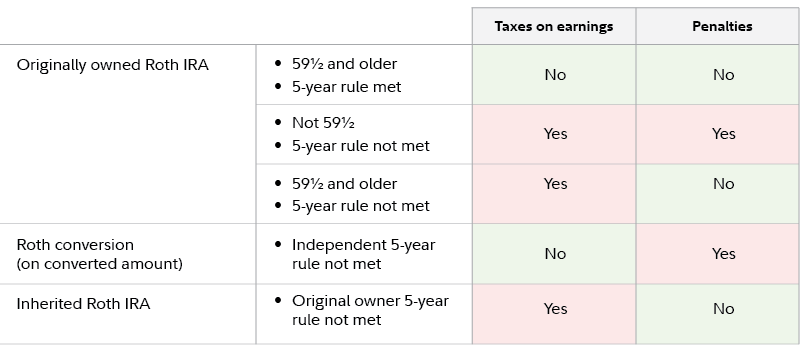
Withdrawing earnings before satisfying the 5-year rule triggers taxes and potential penalties. Your original contributions always come out first, tax-free and penalty-free, but once you tap into earnings from bitcoin appreciation, the IRS treats it as a non-qualified distribution.
Non-qualified distributions face two consequences. First, earnings are taxed as ordinary income at your current tax rate. Second, if you're under 59½, you typically face an additional 10% early withdrawal penalty unless you qualify for an exception.
For Bitcoin IRA holders, this matters significantly given bitcoin's volatility. If you contributed $10,000 that grew to $30,000, your first $10,000 withdrawn is your contribution (tax-free). The next $20,000 counts as earnings subject to taxes and penalties if withdrawn before the 5-year mark and other requirements are met.
Exceptions to the 10% penalty include:
- First-time home purchase: Up to $10,000 lifetime maximum
- Qualified education expenses: For you, spouse, children, or grandchildren
- Unreimbursed medical expenses: Exceeding 7.5% of adjusted gross income
- Disability: Total and permanent disability as defined by IRS
- Substantially equal periodic payments: Following IRS Section 72(t) rules
Even with penalty exceptions, the 5-year rule still applies for tax-free treatment of earnings. You might avoid the 10% penalty but still owe income tax on earnings if the 5-year period hasn't elapsed.
How Does the 5-Year Rule Apply to Bitcoin IRA Conversions?
Converting a traditional IRA to a Roth IRA triggers a separate 5-year rule. Each conversion has its own five-year clock for penalty-free withdrawal of the converted amount, distinct from the 5-year rule for earnings on your original Roth contributions.
If you convert $50,000 of bitcoin from a traditional IRA to a Roth IRA, you pay taxes on that conversion in the year it occurs. However, if you withdraw that converted amount before five years pass and you're under 59½, you face a 10% penalty on the withdrawn conversion amount.
This creates multiple timelines to track. Your original Roth contributions have one 5-year clock for earnings. Each conversion you perform has its own 5-year clock for penalty-free access to the converted principal. For Bitcoin IRA holders doing multiple conversions over several years, this requires careful record-keeping.
The withdrawal order matters:
- First: Original Roth contributions (always tax-free and penalty-free)
- Second: Conversion amounts, oldest first (taxed at conversion, potential penalty if under 5 years)
- Third: Earnings on contributions and conversions (subject to 5-year rule and age/qualifying event)
According to IRS guidance, if you're over 59½ when you take a distribution, the 5-year rules for conversions don't apply. The conversion amounts come out penalty-free regardless of how long ago you converted. However, the 5-year rule for earnings still applies for tax-free treatment.
What About Inherited Bitcoin IRAs and the 5-Year Rule?
Inherited Roth IRAs follow different 5-year rule applications depending on whether the original owner satisfied their 5-year holding period. If the deceased owner held the Roth IRA for five years, beneficiaries receive all distributions tax-free, including earnings. If not, beneficiaries may owe taxes on earnings even though they inherited the account.
Beneficiaries don't start their own 5-year clock. The original owner's clock determines qualified distribution status. A spouse beneficiary who treats the inherited Roth IRA as their own uses their own 5-year clock (or the deceased spouse's clock if earlier).
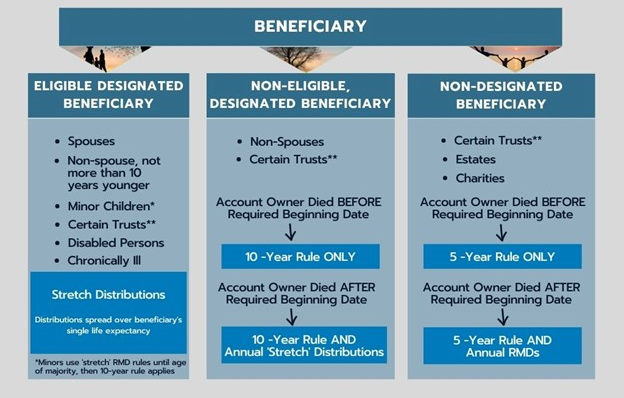
The SECURE Act changed inherited IRA distribution rules for most non-spouse beneficiaries. They must now deplete the inherited account within 10 years of the owner's death. This interacts with the 5-year rule by potentially forcing distributions before the original owner's 5-year period completes, triggering taxes on earnings.
Inherited IRA After 2019: SECURE Act Applies
For Bitcoin IRAs specifically, this timing matters given bitcoin's price volatility. Forced distributions during a bitcoin price peak could mean larger taxable amounts if the original owner hadn't satisfied the 5-year rule before death.
How Do You Track the 5-Year Rule for Your Bitcoin IRA?
Tracking your 5-year timeline requires documentation of your first Roth contribution date. Your IRA custodian should maintain these records, but personal documentation provides backup verification. Keep Form 5498 from the year you made your first Roth IRA contribution, as this IRS form reports contributions to retirement accounts.
For Bitcoin IRAs with multiple conversions, maintain a spreadsheet tracking each conversion date and amount. This helps calculate which funds are accessible penalty-free as each 5-year conversion period expires. Given bitcoin's volatility, knowing exactly when each tranche becomes available prevents costly withdrawal mistakes.
Calendar reminders help manage these timelines. Set reminders for:
- Original contribution 5-year anniversary: When earnings become eligible for tax-free withdrawal
- Each conversion 5-year anniversary: When converted amounts avoid the 10% penalty (if under 59½)
- Age 59½ milestone: When conversion penalties no longer apply regardless of timing
Some Bitcoin IRA providers offer dashboard tools showing your account's qualified distribution status. Platforms like Rhino Bitcoin provide comprehensive Bitcoin IRA services with account management features that help track contribution and conversion timelines.
The IRS doesn't send reminders when your 5-year period completes. The responsibility falls on you to track these dates and understand the tax implications of your withdrawals. Tax professionals specializing in cryptocurrency can help verify your qualified distribution status before large withdrawals.
Why Does the 5-Year Rule Matter for Bitcoin Investors?
Bitcoin's volatility makes the 5-year rule particularly significant for Bitcoin IRA investors. A bitcoin position that appreciates 200% or more during your 5-year holding period creates substantial tax-advantaged earnings, but only if you follow the distribution rules correctly. Premature withdrawals can trigger unexpected tax bills on those gains.
The rule encourages long-term holding, which aligns with bitcoin accumulation strategies many investors prefer. Rather than short-term trading, the Roth IRA structure combined with the 5-year rule incentivizes a buy-and-hold approach. This can benefit investors who believe in bitcoin's long-term value proposition.
Tax planning becomes critical around the 5-year mark. If you're approaching five years since your first contribution and anticipate needing funds, waiting until after the anniversary can save significant taxes on bitcoin appreciation. With bitcoin potentially swinging 20-50% in value over months, timing withdrawals after satisfying the 5-year rule maximizes tax efficiency.
Consider this scenario: You contributed $6,000 annually for five years to a Roth Bitcoin IRA, totaling $30,000 in contributions. Your bitcoin holdings are now worth $75,000. Once you satisfy the 5-year rule and reach 59½, that entire $75,000 can be withdrawn tax-free. Withdraw before meeting both conditions, and you owe taxes and penalties on the $45,000 in earnings.
What Common Mistakes Should Bitcoin IRA Holders Avoid?
Confusing contribution accessibility with earnings accessibility represents the most common error. Many investors correctly understand they can withdraw contributions anytime but mistakenly believe this extends to earnings. With bitcoin's high growth potential, earnings often significantly exceed contributions, making this distinction financially meaningful.
Another mistake involves assuming multiple Roth IRAs have separate 5-year clocks. The IRS treats all your Roth IRAs collectively for the earnings 5-year rule. Opening a new Roth Bitcoin IRA doesn't restart your timeline if you already have an established Roth account. The earliest first-contribution date applies across all accounts.
Conversion timing errors also create problems. Some investors convert traditional IRA bitcoin to Roth accounts without understanding each conversion starts its own 5-year penalty clock. Converting large amounts of appreciated bitcoin then needing those funds within five years triggers the 10% penalty if you're under 59½.
Poor record-keeping leads to confusion about which dollars are being withdrawn. The IRS withdrawal ordering rules (contributions first, conversions second, earnings last) protect you somewhat, but without documentation of your contribution and conversion history, determining your tax liability becomes complicated. This matters especially for Bitcoin IRAs where values fluctuate significantly.
Key mistakes to avoid:
- Withdrawing earnings before 5 years and 59½: Triggers taxes and penalties
- Forgetting conversion 5-year clocks: Each conversion has its own timeline
- Not tracking contribution amounts: Makes it harder to prove tax-free withdrawal eligibility
- Assuming the rule applies to contributions: Contributions are always accessible
Frequently Asked Questions
Does the 5-year rule apply to traditional Bitcoin IRAs?
No, the 5-year rule is specific to Roth IRAs. Traditional IRA distributions are taxed as ordinary income whenever withdrawn, with a 10% penalty if taken before 59½ (unless an exception applies).
Can I withdraw my Bitcoin IRA contributions before five years?
Yes, Roth IRA contributions can always be withdrawn tax-free and penalty-free at any time, regardless of the 5-year rule. Only earnings are subject to the 5-year waiting period.
What if I made my first Roth contribution decades ago but just started a Bitcoin IRA?
Your original Roth IRA first-contribution date determines your 5-year clock for all Roth accounts. If you made your first Roth contribution 20 years ago, you've already satisfied the 5-year rule for your new Bitcoin IRA earnings.
Does transferring bitcoin between Roth IRA custodians restart the 5-year clock?
No, custodian-to-custodian transfers don't affect your 5-year timeline. The clock continues uninterrupted as long as the transfer stays within Roth IRA accounts and follows proper procedures.
How does the 5-year rule work if I convert my Bitcoin IRA to Roth over multiple years?
Each conversion year starts its own separate 5-year clock for penalty-free access to that specific conversion amount. You'll need to track multiple timelines if you perform conversions across several years.
Can I satisfy the 5-year rule by age 59½ if I started my Roth IRA at age 57?
No, both conditions must be met independently. Reaching 59½ satisfies one requirement, but you still need to wait five years from your first contribution for earnings to be qualified distributions.
What happens if bitcoin crashes after my 5-year period but before I withdraw?
Market performance doesn't affect qualified distribution status. If you satisfy the 5-year rule and age requirement, your entire distribution is tax-free regardless of whether your bitcoin appreciated or declined since you satisfied those requirements.
Do required minimum distributions apply to Bitcoin Roth IRAs?
No, Roth IRAs have no required minimum distributions during the owner's lifetime. This makes them attractive for long-term bitcoin holding strategies without forced liquidation at age 73.
Planning Your Bitcoin IRA Strategy Around the 5-Year Rule
The 5-year rule should inform your Bitcoin IRA contribution and withdrawal strategy from the start. Starting your Roth Bitcoin IRA earlier maximizes the time until you can access earnings tax-free. Even small initial contributions start the clock, making it worthwhile to open and fund a Roth IRA as early as possible.
Understanding the rule's interaction with bitcoin's 4-year halving cycles adds another strategic dimension. Bitcoin historically shows price appreciation patterns somewhat correlated with its halving schedule. Aligning your 5-year Roth timeline with potential bitcoin appreciation cycles could maximize tax-free gains, though past performance doesn't guarantee future results.
Consider your overall retirement timeline when deciding between Roth and traditional Bitcoin IRAs. If retirement is more than five years away and you expect to be in a lower tax bracket in retirement, a traditional IRA might make sense. If you're already in a lower bracket or anticipate higher future tax rates, Roth accounts with their 5-year rule offer tax-free growth potential worth the wait.
Key planning considerations include:
- Start your Roth IRA early to begin the 5-year clock
- Make at least a small contribution initially to establish your timeline
- Consider your age and how it interacts with the 5-year and 59½ requirements
- Plan conversions strategically if moving traditional IRA bitcoin to Roth
For those ready to build tax-advantaged bitcoin holdings with proper retirement planning, explore Rhino Bitcoin's Bitcoin IRA options to start your 5-year timeline toward tax-free bitcoin gains.
References
- Internal Revenue Service. "Publication 590-B: Distributions from Individual Retirement Arrangements (IRAs)." https://www.irs.gov/publications/p590b
- Internal Revenue Service. "Roth IRAs." https://www.irs.gov/retirement-plans/roth-iras
- Internal Revenue Service. "Retirement Topics - Exceptions to Tax on Early Distributions." https://www.irs.gov/retirement-plans/plan-participant-employee/retirement-topics-tax-on-early-distributions
- Internal Revenue Service. "Retirement Plan and IRA Required Minimum Distributions FAQs." https://www.irs.gov/retirement-plans/retirement-plans-faqs-regarding-required-minimum-distributions
- U.S. Congress. "Setting Every Community Up for Retirement Enhancement (SECURE) Act of 2019." https://www.congress.gov/bill/116th-congress/house-bill/1994
Important Disclaimers
Disclaimer: Educational information only. Not financial, legal, medical, or tax advice.
Risk Warnings: All investments carry risk, including loss of principal. Past performance is not indicative of future results. Bitcoin is a volatile asset and may not be suitable for all investors.
Conflicts of Interest: Rhino Bitcoin provides Bitcoin financial services. This content is educational and may reference our products.
.png)
.png)